The Dormant SKU (Part 2)
The Same Truck, a Different Ending. Two Agave Brands. One Distributor. Two Fates.

TL;DR
Two agave brands put the same number of cases on the same truck, through the same distributor, in the same month. Eighteen months on, one is growing and one is asleep in a warehouse. What split them was not the product, and it was not the distributor. It was a run of small choices about who sells and who owns the result. The brand that won did not go find a better distributor. It stopped renting a job it needed to own. Both brands are composites, built from real engagements. The pattern is not.

The Same Starting Line
Picture two agave brands. Same price tier, seven SKUs apiece, both landing their first out-of-state distribution the same month. As it happened, their cases rode the same truck. On paper you could not have told them apart. Call them Brand A and Brand B. Composites, both of them, built from real engagements, though nothing here is dressed up for effect.
They even shared an antagonist. Not a villain. The distributor that took both brands was a good one, competent and solvent, the kind you would want. Its rep would carry Brand A and Brand B into the market next to more than five hundred other labels. He would warehouse them, invoice for them, deliver them. He would not sell them, because selling them was never the job. Part 1 called that the category error at the heart of the system. Here it runs twice, side by side, under controlled conditions.
Ninety days in, both founders opened the same file. The monthly depletion report, the first honest look either of them would get at whether a single human being was actually buying the stuff. Same morning. Same number. Flat.
The Fork
Same report. Same zero. This is the morning the twins stop being twins.
Brand A’s founder does the intuitive thing, the thing that feels like momentum. He hires a commission-only broker to handle the market, signs, and exhales. Someone with relationships owns the problem now. His calendar clears. It feels like the week the brand finally got serious. It is worth sitting a second with how reasonable that all is.
Brand B does the harder thing. She gets in the car, a rental with somebody else’s coffee cup still in the console, and drives to her three biggest target accounts herself. She does not drop samples and leave. She gets behind the bar with the staff and walks them through the liquid, one pour at a time, because she knows where this category actually turns. Not the shelf. The bar. On-premise spirits held 46.9% of on-premise spending in 2025 and gained share while the retail shelf shrank around it, and the trial that happens on that floor is the trial that follows people home.
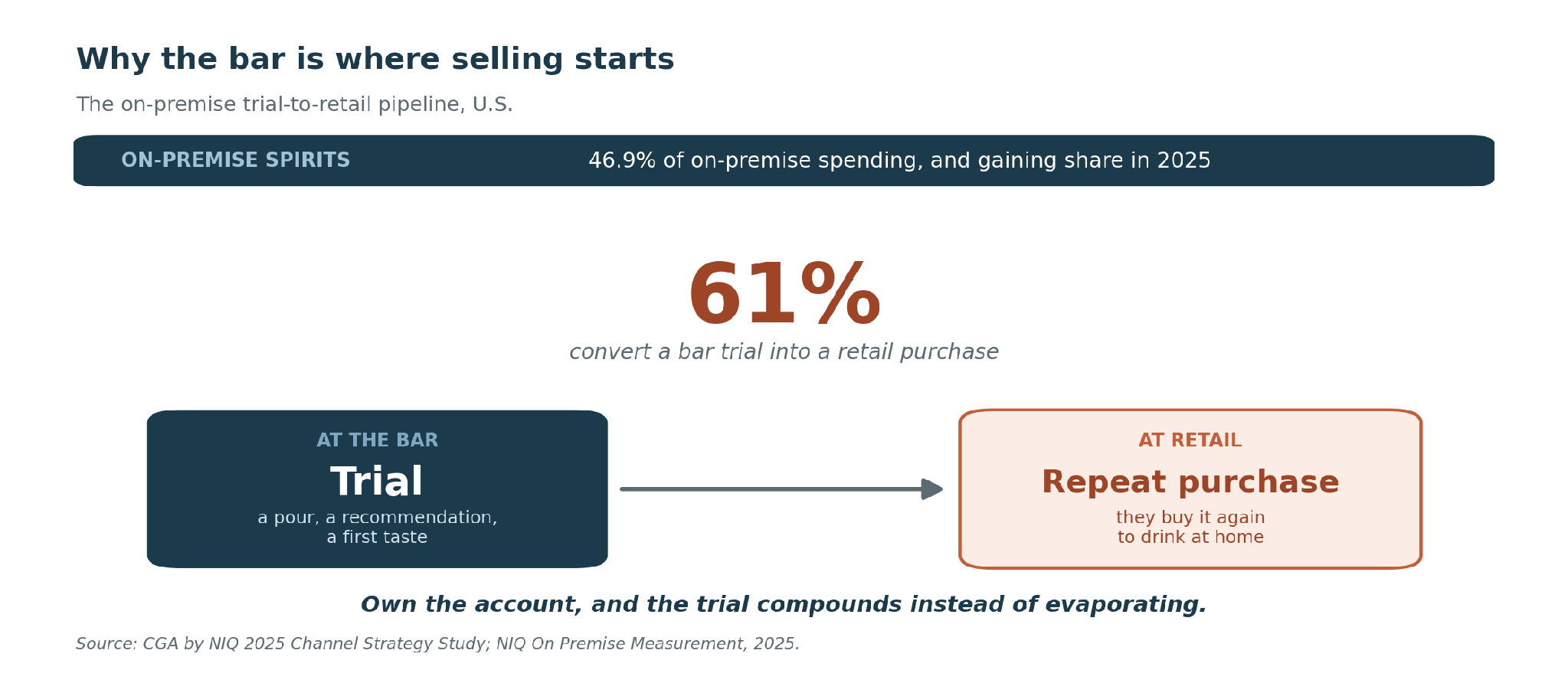
Figure 1. The on-premise trial-to-retail pipeline. Human selling still changes outcomes in the one channel that is growing.
The difference here is not effort. Brand A’s founder worked hard too; signing a broker is work. The difference is what each of them asked the market to do. Brand B built demand in the cheapest place there is to build it. Brand A paid a stranger to place a brand nobody had asked for yet. And presence, it turns out, is not a nicety. In one documented engagement, the markets with a real human working the accounts ran 2.3 times the velocity of the markets without one. Same brand. Different rooms.
For brands: hire an outside rep to open doors, not to conjure demand. A good broker speeds up pull-through you already have. Almost none can create it from nothing. Before you sign, read the agreement for one thing: does it promise a demand outcome, or only a placement?
The Pitch
Three months on, Brand B is across a table from a buyer at a regional chain. She does not open with her brand. She opens with his shelf.
“You’ve got five vodkas,” she says, “and nothing credible in agave over forty bucks. This is the bottle that fills the hole. It carries a fifty-five percent margin.” That is not a brand pitch. It is a portfolio-gap pitch, and it lands because it speaks the language buyers actually think in. At the 2026 ACSA conference, retail buyers said it out loud: they want velocity over variety. A distributor executive put it flatter still. Every SKU has to justify its space. Name the gap and you have done the buyer’s job for him. Lead with your passion and you have handed him homework.
The stakes in that room were bigger than they looked. A placement across a thirty- or forty-store regional chain runs 360 to 960 cases a year at the velocities a young brand actually posts. The average small producer moves 531 cases in a year, across everything it does. One yes from this one buyer was larger than the whole rest of the business put together.
Across town, Brand A’s broker was doing what commission-only brokers do. He carried twelve other lines. Brand A was one of them, one email in a stack of pitches, and the buyer got a one-pager that looked like the other eleven.
Watch the number turn. By week eleven, three of Brand B’s accounts had reordered on their own, no follow-up call required. Brand A had reordered nowhere. Same liquid. Same price. The same distributor, remember. One brand had put a person in the room with a reason for the buyer to say yes. The other had sent paper.
Three reorders is not the finish line, to be clear. The finish line, the point where a brand walks into a distributor negotiation with leverage instead of hope, looks like ten accounts reordering at two or more cases a month, better than eighty percent of the time. That was the number Brand B was building toward, and it was hers. Brand A was waiting on a report that belonged to someone else.
For brands: pitch the portfolio gap, not the brand story. A buyer is running a category P and L, not hosting a passion project. Before your next meeting, write the one sentence that names the hole you fill, by price, flavor, or occasion. Cannot write it? You are not ready to be in the room.
The Stress Event
Then the ground moved, the way it has been moving under this whole industry since 2025.
The distributor both brands shared pulled out of the state. Not because either brand had done anything wrong. Not with much warning either. One decision, in a room they were never in, and by that same afternoon both brands were orphaned. This is not a hypothetical I reached for. It is the RNDC story and the consolidation wave behind it, and it is exactly the kind of event that turns a quiet weakness loud.
Brand B opened her laptop and started dialing. Fifteen accounts, every one of them by name, and here is the part that mattered. They were hers to take. Her contract said so, in writing, in language most founders never think to ask for. An account-list-ownership clause. A change-of-control right that let her walk the day the distributor changed hands. Inside a few weeks her product was moving again through a new route to market, the account base intact, because the accounts were legally hers to move. The distributor had been a truck. The relationships were the asset, and the asset left with her.
Brand A’s founder reached for his broker and found out what rented attention is worth the moment the rent stops. He had signed the template, the clean one, the one with none of those clauses in it. His accounts lived in the broker’s book and the distributor’s CRM. Never his. He had no standing to object to the sale and no right to leave for a partner he actually wanted. When the truck stopped, he had no one to call, and spent the exit window trying to rebuild his own account list from memory. He knew where his product was parked. He could not have told you who was buying it.
None of this is a thought experiment. When RNDC actually came apart, a real agave brand did what Brand B did. Nosotros Tequila had built its California accounts before it needed them, and when the distributor unraveled it switched those relationships back on inside the ninety-day exit window. Its revenue chief said the quiet part plainly: they owned the conversation, they were placing the orders themselves, their people were talking to every buying contact in the state. The brand grew through the disruption that sank other people. The twins are composites. Their endings are not.
For operators: rented attention reverts to the landlord. A broker’s attention, like a distributor’s shelf space, is rentable by the month, and the day a better-paying tenant shows up, or the truck stops, it is gone. If your distributor and your broker both disappeared tomorrow, could you hold a working line to your top fifteen accounts? If not, it was never really yours.

What Actually Separated Them
Step back from the two founders and ask what actually did the work here, because most of the obvious answers are wrong.
Not effort. They both worked hard; one of them just worked hard at the wrong thing. Not budget either, because that broker cost Brand A real money. Not the product, not the price, not the distributor, since they shared all three. What separated the twins came down to two questions, and only two. Who owned the account relationship. And whether the money was paid to place the brand or to build it. That is Part 1’s distinction made flesh: paid-to-place against paid-to-build. Brand A paid to place, and rented the result. Brand B paid to build, and kept it.
And she was not spending more to do it. She was spending differently. Distribution priced honestly, as the logistics it actually is, runs fourteen to twenty percent, not the twenty-eight to thirty-five a full-service margin quietly assumes. The gap between those two numbers is the selling function you think you are already buying. Brand B took that gap and put it into selling she owned.
There is a real exception here, and it is worth being honest about. Below a couple of million dollars in revenue, or when one founder plainly cannot be in five states at once, an imperfect outside rep beats no rep at all. So the lesson is not never hire out. The lesson is to know, at every moment, whether you are renting or building, and to never confuse the one for the other.
And here is the quiet scandal sitting under both stories. Nobody can tell you how often Brand A’s ending happens. The industry does not measure it. There is no published number anywhere for how many brokered placements go dark, no dormancy rate, no benchmark for whether a rep actually sold anything. The one function the whole market leans on is the one function nobody counts. Brand A does not show up in the data, because the data was never built to see him. That absence is not a footnote. It is the whole problem, said once and plainly.
Which Twin Is Your Brand?
You do not need a distributor’s report to find out which twin you are. You need seven honest answers to yourself. The reorder is the only vote that counts, so every question here comes back to one thing: whether you can see, name, and keep the accounts casting it.
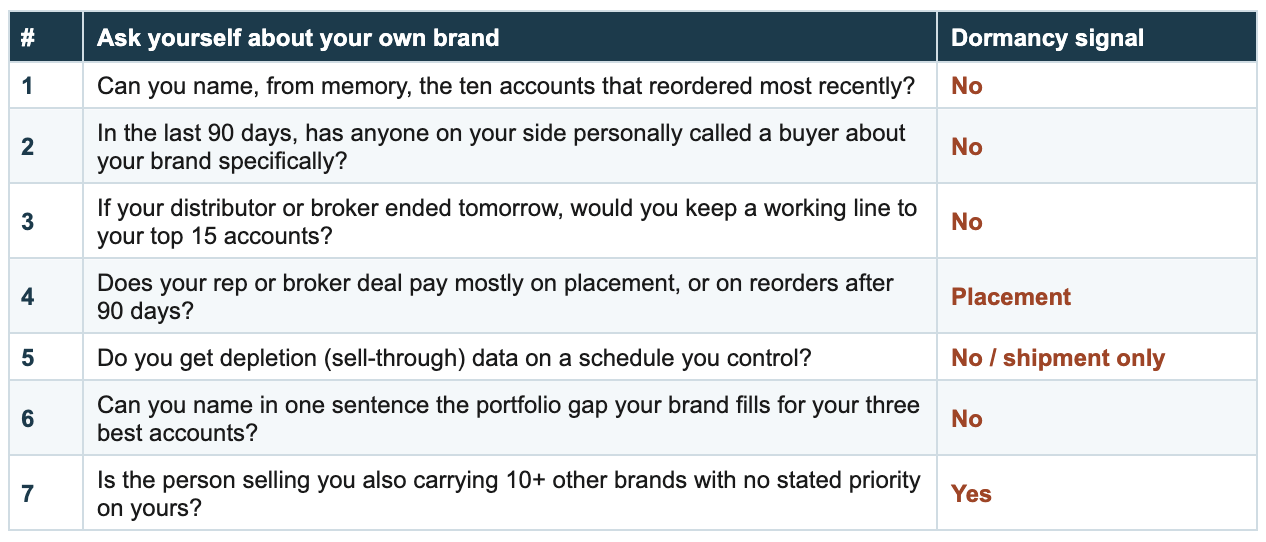
Diagnostic framework, Maguey Exchange; buyer-behavior grounding from ACSA 2026.
Three or more answers landing in the right-hand column, and you probably have a dormant SKU on your hands, whatever the footprint looks like on paper. The good news is hiding in that same column. Every signal there is also a task, and not one of the fixes runs through a better distributor. They run through you owning the selling.
Come back to the twins one last time. Same truck, same month, the same cases in the same warehouse to start. Eighteen months later, one founder is taking reorder calls from accounts she can name off the top of her head, and the other is still refreshing a report that shows him nothing. Everything between those two mornings comes down to a single asset. Brand B owns it outright. Brand A rented it, and lost it inside a week.
It has a name. The portable account relationship. It is the account you can call yourself, the reorder you can see coming, the buyer who picks up because of your brand and not because of whose truck pulls up to the dock. Part 3 puts a number on it: how you measure it, and what an acquirer will actually pay to get it.
Both brands are still out there tonight. One is selling. One is parked. Part 2 leaves you with a single question, and it is not a comfortable one: which twin is your brand, and would you know it before the truck stopped?
Part 3: how to measure the asset these two brands were quietly building or losing, and what it is worth.